The 14 Pillars of Intelligence: Exploring Machine Learning Types
From traditional Supervised Learning to cutting-edge Quantum ML, the landscape of Artificial Intelligence is diverse and rapidly evolving.

We are a Programming and Technology community. Somos una comunidad de Programación y Tecnología.
In the modern era of data science, there is no "one size fits all" approach to building intelligent systems. Whether it's a spam filter in your inbox or a self-driving car navigating a city, different challenges require different architectural approaches.
Machine Learning (ML) can be categorized by how a model learns and the specific problem it aims to solve. Here is a breakdown of the 14 essential types of ML algorithms as used in the industry today.
1. The Core Learning Styles
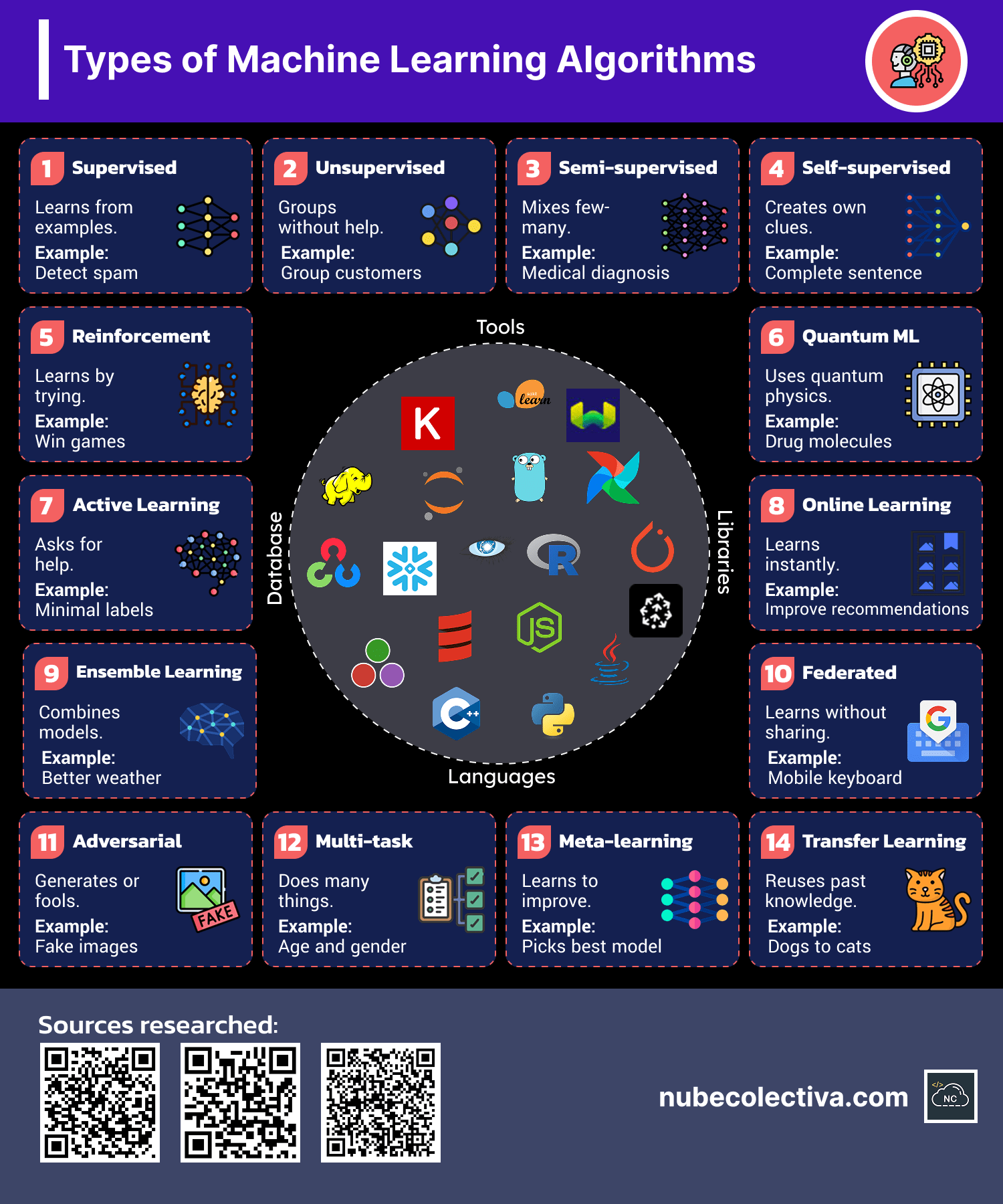
Supervised Learning: The most common form, where models learn from labeled "examples" (e.g., detecting spam).
Unsupervised Learning: The model finds hidden patterns or groups in data without explicit labels (e.g., customer segmentation).
Semi-supervised: A hybrid approach that mixes a small amount of labeled data with a large amount of unlabeled data (e.g., medical diagnosis).
Self-supervised: The model creates its own "clues" from the data to learn (e.g., sentence completion in LLMs).
2. Specialized Training Methods
Reinforcement Learning: Learning through trial and error to maximize a reward (e.g., mastering video games).
Active Learning: The model identifies specific data points it is unsure about and "asks" a human for the label.
Online Learning: Unlike batch processing, these models learn instantly from a continuous stream of data (e.g., real-time recommendation engines).
3. Advanced and Emerging Architectures
Quantum ML: Utilizing the principles of quantum physics to process information at speeds impossible for classical computers (e.g., drug discovery).
Ensemble Learning: Combining multiple models to create a more accurate "super-model" (e.g., complex weather forecasting).
Federated Learning: Training models across decentralized devices (like mobile phones) without ever sharing the private raw data.
Adversarial Learning: A "cat and mouse" game where one model generates data and another tries to catch the fake (e.g., creating or detecting deepfakes).
4. Efficiency and Knowledge Transfer
Multi-task Learning: Training a single model to perform multiple related tasks simultaneously, like predicting both age and gender.
Meta-learning: Often called "learning to learn," where the model optimizes its own learning process to pick the best algorithms.
Transfer Learning: Reusing knowledge from a pre-trained model on a new, related task (e.g., using a model trained on dogs to help identify cats).
The ML Ecosystem: Tools and Languages
Beyond the algorithms, a robust ecosystem is required to bring these models to life. This includes:
Languages: Python, R, Java, C++, and JavaScript.
Libraries & Tools: TensorFlow, Keras, Scikit-learn, PyTorch, and cloud databases like Snowflake.
Gift
In the following image you can see each of the types of machine learning:
Conclusion
The field of Machine Learning is no longer just about simple predictions. It has evolved into a sophisticated discipline ranging from Supervised Learning for daily tasks to Quantum ML for the future of science. Understanding these 14 types allows developers and businesses to choose the right tool for the right job, ensuring more efficient, ethical, and powerful AI solutions.


